

The AI Filmmaking Spectrum
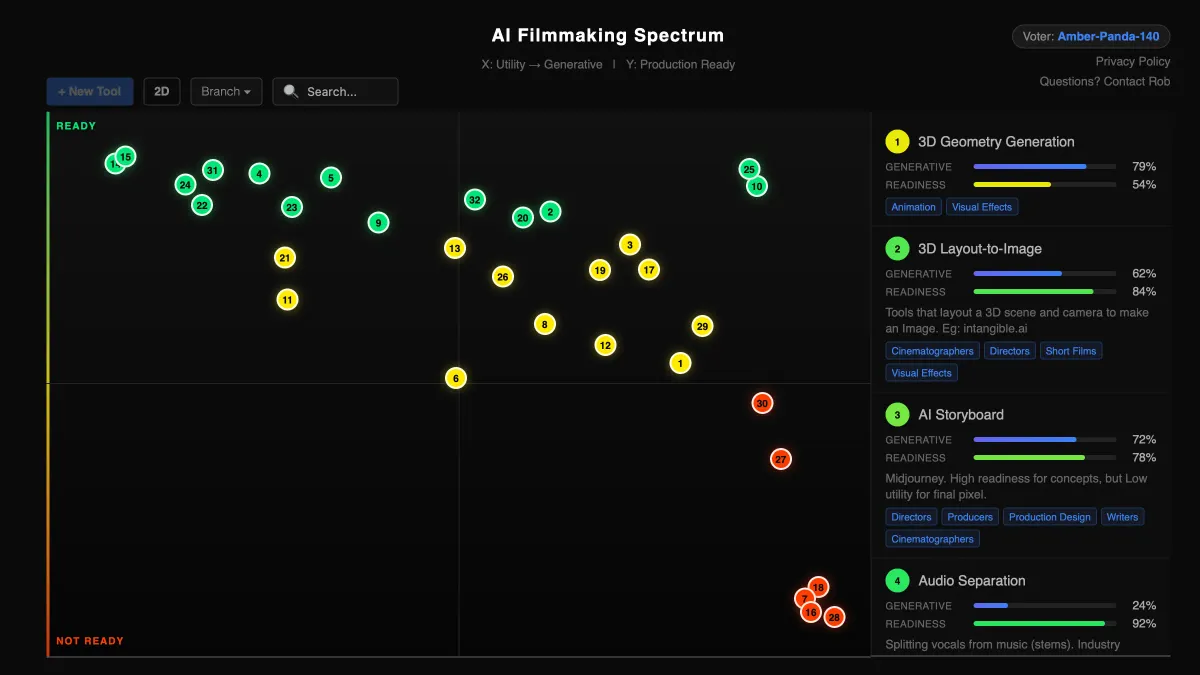
AI is such a broad term that it’s not descriptive enough, especially in relation to filmmaking. I’m interested in how these tools can support creatives, not replace the creative process. Machine-learning tools include utilities we’ve long relied on—like removing noise or grain from a picture, or cleaning up background audio hiss. At the other end are generative tools, like creating images or shots from text prompts, or the theoretical extreme of attempting to produce content with minimal human involvement. It’s a vast spectrum.
Explore the interactive AI Filmmaking Spectrum →
Where the idea came from
I’ve been talking with a lot of people lately to understand how they think about these tools and how to get our heads around the breadth of what “AI” actually covers in our field. I had the idea to build a visual graph that lays out the different kinds of tools that, under the hood, rely on machine learning algorithms and neural network architectures.
For something more straightforward like removing noise from an image, a model is trained on noisy images paired with clean ones to solve a specific technical task. Text-to-video is far more complex, starting with noise and iteratively refining it toward a prompt description. While both rely on similar neural network fundamentals, the creative, ethical, and practical workflows for filmmakers are world’s apart.
And somewhere along that spectrum, every artist and filmmaker draws their own line regarding which tools belong in their process. I wanted to visualize those perspectives.
A tool to talk about AI
What do people think about these AI tools? This isn’t designed to represent “ground truth” or a single opinion, but an informal snapshot of how different creatives view these tools today. It lets you rate each tool used in filmmaking on two axes:
- How production-ready is it? How far along is it in its evolution—is it something you’d trust on a real production today, or is it still a tech demo?
- How algorithmic vs. generative is it? Is it essentially a specialized version of an algorithm with a clear target answer it’s solving for? Or does the tool generate open-ended outputs that require human creative direction?
What I’ve learned sharing it
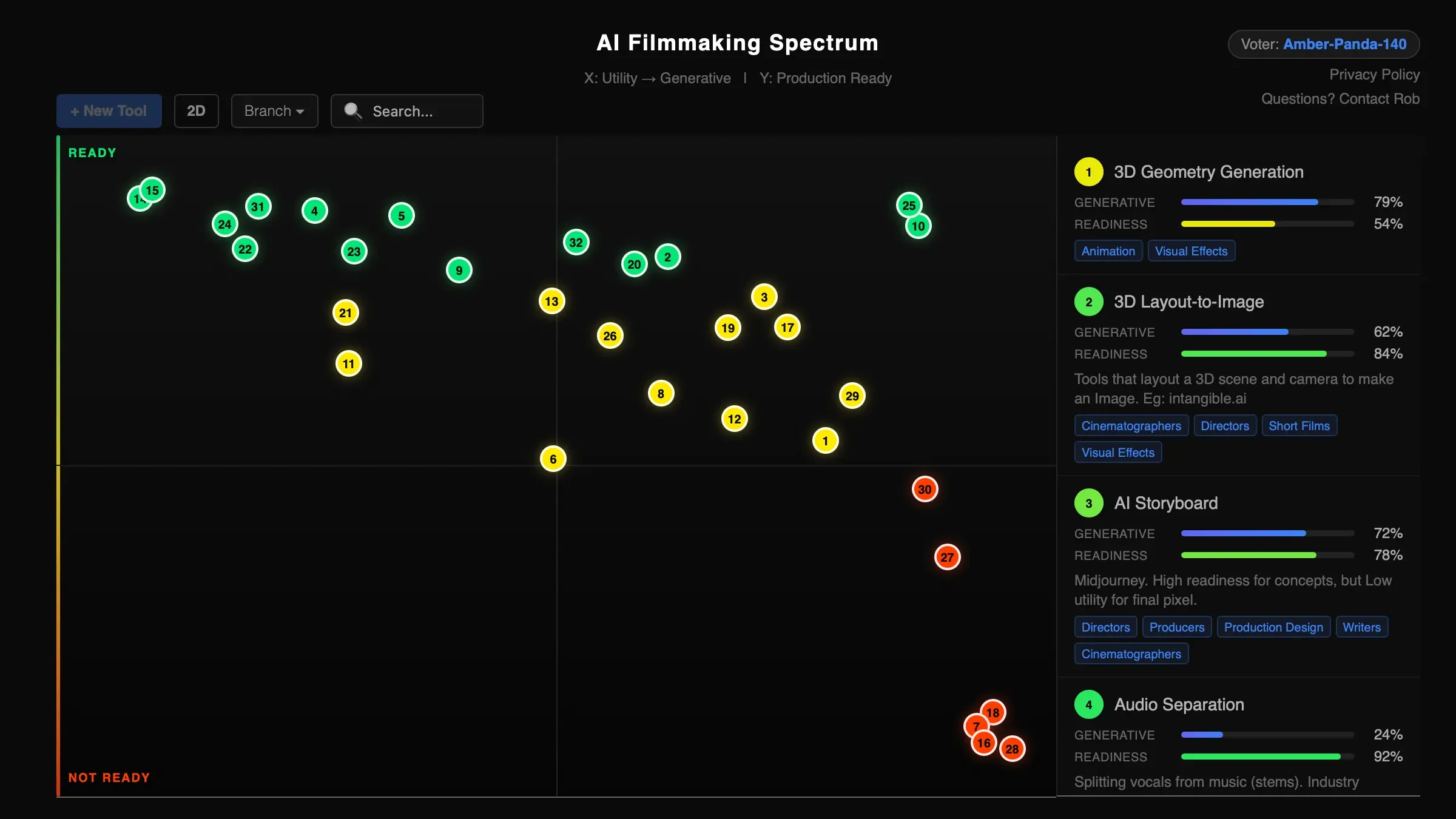
I’ve had the chance to share the AI Filmmaking Spectrum with hundreds of fellow filmmakers, technicians, engineers, artists, independent creators, and industry peers across organizations like The Academy. The feedback and discussions have been incredibly insightful.
Many participants have voted on tool positions and suggested new examples, making the dataset a fascinating qualitative snapshot of how people see the landscape today.
Because you can vote on a tool’s placement and watch the plot adjust to collective input, it drives home how subjective this topic is. How useful, intrusive, algorithmic, or generative a tool feels depends entirely on your personal workflow and artistic philosophy. There’s no single objective answer—it’s a nuanced topic with a lot of variables. This is just one way to look at it.
A few notes on how it works
When I use the spectrum in live interactive sessions, I open up voting and tool additions so attendees can drag tools around and see the graph update live. Outside of those interactive sessions, voting is kept off to prevent spam and ensure the collected dataset reflects genuine, thoughtful input from active practitioners.
If you have ideas, contact me and let me know which tools you’d like to see added or even add your voice to how they are positioned on the chart.
You can explore the live version here.